Showing posts with label French. Show all posts

Tuesday, June 23, 2020

Étienne Terrus – French painter

Étienne Joseph Mathieu Terrus was born on 22 September 1857 in Elne, Pyrénées-Orientales and died 0n 22 June 1922 in Elne, although he lived most of his life in Roussillon, also in the Pyrenees. He was a French painter.

Etienne Terrus was one of water-colourist who lived from 1857 to 1922 was barely known outside of his native town of Elne, near Perpignan.

Despite the fact he studied at age 16 at the École des BeauxArts in Paris and was friends with Henri Matisse and Aristide Maillol, Terrus is little known outside south-western France’s Roussillon region, near the borders with Spain and Andorra. Even in the town where he was born in 1857 it can be hard to find any sign of the painter.
Étienne Terrus – French painter

Saturday, October 26, 2019

Jean-Léon Gérôme (1824-1904)

Jean-Léon Gérôme was born in Vesoul (Haute-SaOne) on May 11, 1824. He was a major French painter. The son of a provincial goldsmith, Gérôme was accepted into the Paris studio of the painter Paul Delaroche, where he studied until 1843.

The painting "The Cock Fight" exhibited at the 1887 Salon launched his carrier. He won a third-class medal and the painting became the property of the State. Gérôme 's career was extremely productive (over 550 paintings and 75 sculptures) and successful.

From 1855, Gérôme regularly travelled to the East coast of the Mediterranean Sea. In 1857, he travelled along side Emile Augier and August Bartholdi in Egypt. In 1859 he showed the first Egyptian genre painting at the Salon, showing an innovative view of the Middle-East. Gérôme also exhibited three historical works: "King Candaules", "Ave Caesar" and "Death of Caesar".

Gérôme also travelled to Syria, Jordan (1862), Jerusalem (1868), Spain (1873) and Algeria (1873, 1883). The frequent trips to the Middle East provided the artist with interesting themes, as well as allowing him to amass a collection of Oriental artistic craftwork, which became his store of props.

Gérôme was in his prime at the time the Art Institute was established in 1879. His art had been purchased by American collectors for more than thirty years when his first work entered the museum in 1893. The five examples by Gérôme in the Art Institute, acquired over a ninety-five-year period, span his career and represent several aspects of his art. The group is comprised of three paintings, Portrait of a Lady (Rosine Faivre?) (1851), The Chariot Race (1876), and Love Conquers All (1889); and two sculptures, Anacreon with the Infants Bacchus and Cupid (1881), and Bonaparte Entering Cairo (1897).
Jean-Léon Gérôme (1824-1904)

Tuesday, January 17, 2017

Paul Gauguin

Eugène Henri Paul Gauguin was born on June 7 1848, in Paris, France. His mother, Aline Ghazal, was the daughter of the famous writer Flora Tristan. His father Clovis Gauguin was a journalist.

He spent his childhood in Lima, Peru between 1851 and 1855. In 1868 Gauguin enlisted in the French navy. While in the navy, he fought in the Franco-Prussian War. When the French lost, Gauguin return home.

Paul Gauguin
After resigned from the Navy in 1871 he found a job on the Paris Stock Exchange with the firm Bertin as stockbroker. He made a considerable fortune and led the life of a well-to-do bourgeois. He met Emile Schuffenecker and took up painting with him in his spare time.

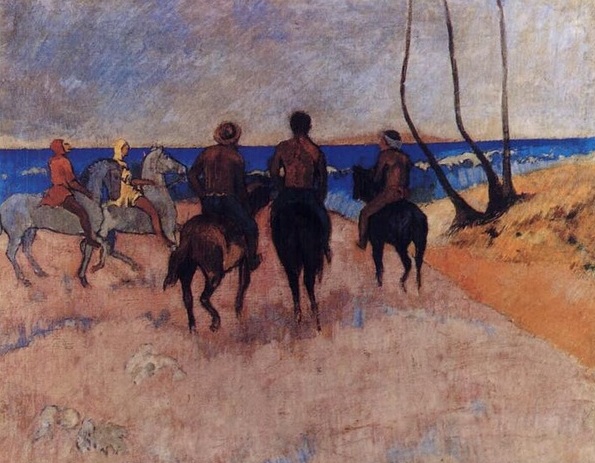
Horseman on the beach
Gauguin created paintings, drawings and pottery. He experimented with the styles of other artists. Then he used what he learned from their work to create his own style.

In 1886 Gauguin took part in the 18th Impressionist exhibition with one sculpture and eighteen paintings revealing Pissarro’s influence. Gauguin died on May 8 in 1903 on the island of Hiva Oa.
Paul Gauguin

The Most Popular Posts

Other Interesting Articles

  • Richard Alan Gardner (1931–2003) was an American child psychiatrist, psychoanalyst, author, and clinical professor whose career spanned several decades. ...
  • Tea first arrived in the United States in the 1600s, brought by European settlers who introduced the beverage to the American colonies. By the 18th century...