Georges Seurat was born in Paris on 2 December 1859 into a middle-class family. Georges was the son of Antoine-Chrisostôme Seurat, a 44-year-old property owner, originally from Champagne, and Ernestine Faivre, a Parisienne.
Georges Seurat decided early on to become an artist. He studied at a municipal drawing school under the sculptor Justin Lequien. Then worked 1878-80 at the Ecole des Beaux-Arts in the studio of Lehmann, a pupil of Ingres.
In 1879, he saw an exhibition by some young painters called the Impressionists. They were not popular at the time because they painted in a new way. After training at the École des Beaux-Arts, Georges Seurat broke free of tradition. Seurat combined a traditional approach, based on his academic training, with a study of modern techniques, such as Impressionism. He also applied ideas from contemporary optical theories of colour relationships. Seurat's disciplined work, which contrasts with that of many of his Impressionist contemporaries, was very influential.
Seurat was also interested in the science behind the art, and he did a good deal of reading on perception, color theory and the psychological power of line and form.
In 1884 he and other artists (including Maximilien Luce) formed the Societe des Artistes Independants. There he met and befriended fellow artist Paul Signac.
In the summer of 1884 Seurat began work on his masterpiece, Sunday Afternoon on the Island of La Grande Jatte, which took him two years to complete.
Georges Seurat (1859–1891)
The term "history of painting" refers to artworks depicting scenes drawn from classical sources like mythology, the Bible, and legends. This history provides valuable insights into how people and societies have interacted with the art of painting. Studying painting history is essential, as it reveals the evolution of artistic expression and cultural values. The past shapes the present, which, in turn, influences the future.
Showing posts with label post-impressionist. Show all posts
Friday, June 24, 2022
Monday, June 26, 2017
Post-Impressionist
Post-Impressionism is painting the psychological feeling or sensation of things. Or more briefly the old way was representation; the new way is – expression.
The term ‘Post-Impressionism’ has only one meaning: ‘after Impressionism’. Impressionism being a phenomenon unique to French painting, the idea of Post-Impressionism is also closely linked to French art.
Generally, the beginning of the Pos-Impressionist era dates from 1886, from the moment of the eighth and final joint Impressionist Art exhibition.
The term was coined for Roger Fry’s London exhibition “Manet and the Post- Impressionists” in 1910, which included Cezanne, Gauguin, van Gogh, Matisse and Picasso; the Second Post-Impressionist Exhibition in 1912 included the Fauves, Vlaminck, Derain, and Braque.
Post-Impressionist
The term ‘Post-Impressionism’ has only one meaning: ‘after Impressionism’. Impressionism being a phenomenon unique to French painting, the idea of Post-Impressionism is also closely linked to French art.
![]() |
| Picasso |
The term was coined for Roger Fry’s London exhibition “Manet and the Post- Impressionists” in 1910, which included Cezanne, Gauguin, van Gogh, Matisse and Picasso; the Second Post-Impressionist Exhibition in 1912 included the Fauves, Vlaminck, Derain, and Braque.
Post-Impressionist
Tuesday, January 17, 2017
Paul Gauguin
Eugène Henri Paul Gauguin was born on June 7 1848, in Paris, France. His mother, Aline Ghazal, was the daughter of the famous writer Flora Tristan. His father Clovis Gauguin was a journalist.
He spent his childhood in Lima, Peru between 1851 and 1855. In 1868 Gauguin enlisted in the French navy. While in the navy, he fought in the Franco-Prussian War. When the French lost, Gauguin return home.
After resigned from the Navy in 1871 he found a job on the Paris Stock Exchange with the firm Bertin as stockbroker. He made a considerable fortune and led the life of a well-to-do bourgeois. He met Emile Schuffenecker and took up painting with him in his spare time.
Gauguin created paintings, drawings and pottery. He experimented with the styles of other artists. Then he used what he learned from their work to create his own style.
In 1886 Gauguin took part in the 18th Impressionist exhibition with one sculpture and eighteen paintings revealing Pissarro’s influence. Gauguin died on May 8 in 1903 on the island of Hiva Oa.
Paul Gauguin
He spent his childhood in Lima, Peru between 1851 and 1855. In 1868 Gauguin enlisted in the French navy. While in the navy, he fought in the Franco-Prussian War. When the French lost, Gauguin return home.
![]() |
| Paul Gauguin |
|
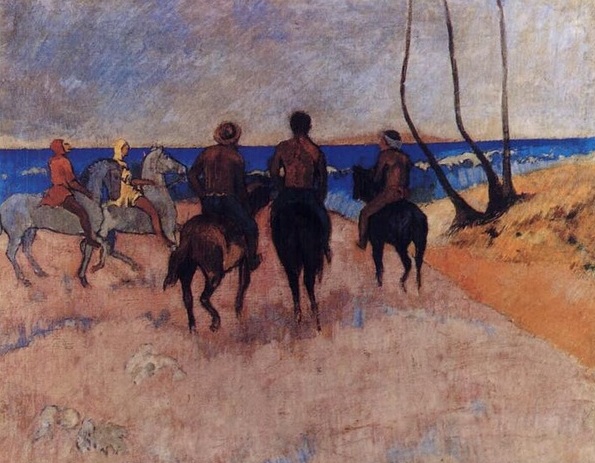
Horseman on the beach
|
In 1886 Gauguin took part in the 18th Impressionist exhibition with one sculpture and eighteen paintings revealing Pissarro’s influence. Gauguin died on May 8 in 1903 on the island of Hiva Oa.
Paul Gauguin
Subscribe to:
Posts (Atom)
The Most Popular Posts
-
Vincent van Gogh painted the picture in April-May 1885, at Nuenen, where van Gogh’s parents had lived since 1883. Vincent lived there for t...
-
Dora Maar au Chat It was painted in 1941 by Pablo Picasso. It depicts Dora Maar, the painter’s Croatian mistress, seated on a chair with s...
-
Art in the Old Stone Age From the moment in 1879 that cave paintings were discovered at Altamira , scholars wondered why the hunters of the ...
-
The Chaldeans came originally from northeast Mesopotamia and took control of Babylon in 625 BC. Geographically, Chaldea occupied a central...
-
In 1892, Matisse began study with Gustavo Moreau. After 5 years Moreau told Matisse that it was time for him to produce a major work to demo...