Showing posts with label engraver. Show all posts

Monday, May 6, 2024

Asher Brown Durand: Pioneering American Landscape Painter

Asher Brown Durand, widely regarded as the "father of American landscape painting," made profound contributions to the art world during the 19th century. Born on August 21, 1796, in Maplewood, New Jersey, Durand's artistic journey was marked by innovation and a deep appreciation for nature.

Durand initially learned engraving from his father, a skilled watchmaker and silversmith, before embarking on an apprenticeship with New Jersey engraver Peter Maverick from 1812 to 1817. This experience laid the groundwork for Durand's future artistic endeavors. By 1817, he had partnered with Maverick, establishing a branch of the firm in New York City, where he soon gained recognition for his intricate engravings.

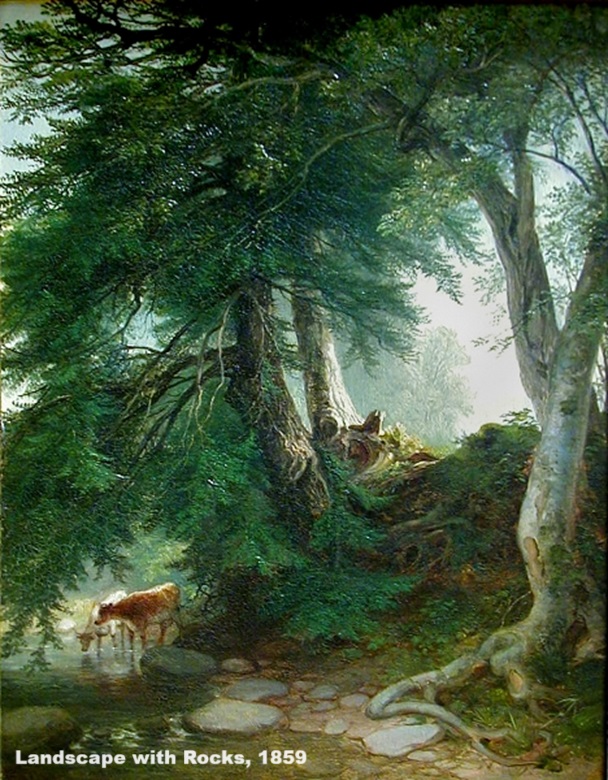
However, it was in the early 1830s that Durand's career took a pivotal turn. Inspired by fellow artist Thomas Cole and supported by influential patron Luman Reed, Durand transitioned from engraving to painting, a shift that would define his legacy. His paintings began to reflect the ethos of the burgeoning Hudson River School, a movement characterized by its celebration of American landscapes.

One of Durand's most acclaimed works, "Kindred Spirits" (1849), epitomizes his artistic prowess. This painting, a tribute to the late Thomas Cole, portrays Cole and poet William Cullen Bryant amidst the picturesque Catskills Mountains. It encapsulates the romanticized vision of nature that defined the Hudson River School.
Durand's artistic vision extended beyond mere landscapes. His 1853 masterpiece, "Progress," commissioned by a railroad executive, depicts America's transformation from wilderness to civilization. The painting unfolds like a historical narrative, illustrating the country's evolution with elements such as roads, telegraph wires, and bustling industry, juxtaposed against the serene backdrop of nature.

In addition to his artistic endeavors, Durand played a pivotal role in shaping American art institutions. He served as the president of the National Academy of Design, leaving an indelible mark on the American art scene.

Asher Brown Durand passed away on September 17, 1886, in Maplewood, New Jersey, leaving behind a profound legacy. His contributions not only defined an era of American art but also paved the way for future generations of landscape painters. Durand's enduring influence continues to resonate, underscoring his significance as a pioneer of American artistic expression.
Asher Brown Durand: Pioneering American Landscape Painter
Saturday, August 15, 2015

Albrecht Dürer (1471-1528)

Considered one of the greatest Graphic Artists in history, Albrecht Dürer elevated printmaking to the level of painting through his unprecedented use of line and value.  Albrecht Durer, born on May 21, 147, was the third of 18 children born to Albrecht Dürer, a goldsmith who had moved to Nuremberg, Germany from the Kingdom of Hungary and Barbara Holfer, the daughter of Albrecht Dürer the Elder’s master.

His precocious skill is evidenced by a remarkable self-portrait done in 1484, when he was 13 years old, and by a Madonna with Musical Angels, done in 1485, which is already a finished work of art in the late Gothic style.
Die Satyfamilie by Albrecht Dürer
In 1486, Dürer was apprenticed to the well-known Nuremberg artist Michael Wolgemut, from whom he learned the fundamentals of painting and printmaking.

After his three year’s apprenticeship was over Dürer went on travel for four years. He went of Venice, certainly to Colmar where the works of Martin Schongauer impressed him.

Through his life, Dürer had significant contact to individuals with health problems and with disabilities.

In 1498 appeared Dürer’s sixteen great woodcuts of the ‘Apocalypse; which introduced a new epoch in the art of wood-engraving. In 1507, he journeyed home, where he formed a school and pupils and apprentices gathered around him.

Dürer built his reputation with graphic works such as the Large Passion and Small Passion and the Life of the Virgin, which were published in 1511, as well as by accepting painting commission.
Albrecht Dürer (1471-1528)

Friday, December 5, 2008

Rembrandt van Rhyn

Rembrandt van Rhyn
Rembrandt van Rhyn, one of the most eminent painters and engravers of the Dutch school, was the son of a miller, and was born in 1606, at a small village on the banks of the Rhine, between Leyderdorp and Leyden, whence he was called Rembrandt van Rhyn, though his family name was Gerretz.

It is said that his father, being in easy circumstances, intended him for one of the learned professions, but was induced by Rembrandt’s passion for the art to allow him to follow his inclination.

Rembrandt had already brought both the arts of painting and engraving to very great perfection, when a slight incident led him to fame and fortune. He was induced by a friend to take one of his choicest pictures to a picture-dealer at The Hague, who, being charmed with the performance instantly gave him a hundred florins for it, and treated him with great respect. This occurrence served to convince the public of his merit and contributed to make the artist sensible of his own abilities.

Though Rembrandt excelled as a painter of history and portrait, and especially in the latter, he is much better known as an engraver. Some of his prints are deservedly famous for the excellent of the clare obscure, as it seen in a supposed, or accidental light; others are remarkable for the extravagance of that principle. He copied nature with all its defects, as he saw it in his own country; and even this he sometimes debased, but seldom rose above it. There is a vein of good sense running through his works. His print of Christ healing sick, esteemed the most capital of his etchings, sold for thirty guineas: his portrait of the Burgomaster Six, has sold for more.
Rembrandt van Rhyn

The Most Popular Posts

Other Interesting Articles

  • Richard Alan Gardner (1931–2003) was an American child psychiatrist, psychoanalyst, author, and clinical professor whose career spanned several decades. ...
  • Tea first arrived in the United States in the 1600s, brought by European settlers who introduced the beverage to the American colonies. By the 18th century...