Nestled within the heart of central India lies the enigmatic treasure trove of history known as the Bhimbetka rock shelters. Spanning epochs from the Paleolithic to the historic period, these shelters serve as a vivid testament to the earliest human habitation in the region.
At the core of Bhimbetka's allure are its prehistoric cave paintings, dating back to as early as 10,000 BCE, offering a window into the lives of our ancient ancestors. These masterpieces depict a myriad of themes, ranging from vibrant scenes of hunting and dance in the Stone Age to the majestic presence of mounted warriors, possibly from the Bronze Age, evoking a sense of awe and wonder.
What sets these paintings apart is not just their antiquity but also the remarkable palette employed by the artists. Utilizing a diverse array of colors extracted from minerals and rocks, the artisans of Bhimbetka infused their creations with life. From the earthy tones of red ochre to the vibrant hues of purple and green, each stroke speaks volumes about the ingenuity and creativity of its creator.
Yet amidst this rich tapestry of colors, white and red emerge as perennial favorites, lending a timeless elegance to the artwork. Through meticulous grinding and blending, these ancient artists transformed raw materials into vibrant pigments, breathing life into their visions.
In essence, the Bhimbetka rock shelter paintings stand as a testament to the indomitable spirit of human creativity, transcending time to offer us a glimpse into our shared heritage. As we marvel at these ancient wonders, we are reminded of the enduring power of art to bridge the chasm between past and present.
Exploring the Rich Tapestry of Bhimbetka Rock Shelter Paintings
The term "history of painting" refers to artworks depicting scenes drawn from classical sources like mythology, the Bible, and legends. This history provides valuable insights into how people and societies have interacted with the art of painting. Studying painting history is essential, as it reveals the evolution of artistic expression and cultural values. The past shapes the present, which, in turn, influences the future.
Showing posts with label India. Show all posts
Tuesday, March 26, 2024
Saturday, March 18, 2023
Tanjore Painting
Thanjavur painting is a classical South Indian painting style, which was inaugurated from the town of Thanjavur (anglicized as Tanjore). During the rule of Cholas, Thanjavur served as the capital of the empire. Even after the defeat of Cholas, the town has been ruled by various dynasties such as Pandya’s, Vijayanagar Empire, Madurai Nayaks, Thanjavur Nayaks, Thanjavur Marathas, and British Empire. Since 1947, it’s been a part of India.
The art form dates back to the early 9th century, a period dominated by the Chola rulers, who encouraged art and literature. Thanjavur paintings furtherly patronized by the Maratha princes, Nayakas of the Vijayanagar Empire, Rajus of Tanjore and Tiruchirappalli, and the Naidus of Madurai.
These paintings are known for their elegance, rich colors, and attention to detail. The themes for most of these paintings are Hindu Gods and Goddesses and scenes from Hindu mythology.
They are characterized by rich, flat, vivid colors and simple iconic composition. Tanjore paintings are panel paintings and it is done on wooden planks and so it is called as palagai padam (palagai - wooden plan , padam-picture ).
The painting would be bright & colourful and breathtakingly beautiful. The impact in a darkened room is that of a glowing presence. While most of the paintings would depict the Child Krishna and his various pranks, paintings of other deities were also created. Now a days it has been use as a colorful pieces of art to decorate walls and many purposes.
Tanjore Painting
The art form dates back to the early 9th century, a period dominated by the Chola rulers, who encouraged art and literature. Thanjavur paintings furtherly patronized by the Maratha princes, Nayakas of the Vijayanagar Empire, Rajus of Tanjore and Tiruchirappalli, and the Naidus of Madurai.
These paintings are known for their elegance, rich colors, and attention to detail. The themes for most of these paintings are Hindu Gods and Goddesses and scenes from Hindu mythology.
They are characterized by rich, flat, vivid colors and simple iconic composition. Tanjore paintings are panel paintings and it is done on wooden planks and so it is called as palagai padam (palagai - wooden plan , padam-picture ).
The painting would be bright & colourful and breathtakingly beautiful. The impact in a darkened room is that of a glowing presence. While most of the paintings would depict the Child Krishna and his various pranks, paintings of other deities were also created. Now a days it has been use as a colorful pieces of art to decorate walls and many purposes.
Tanjore Painting
Friday, February 10, 2023
Kalamkari painting
Andhra Pradesh is a center of the arts of Kuchipudi dance, melodious songs, and various crafts, of which Kalamkari is one of the most significant arts. Kalamkari was first used to portray scenes from sacred texts such as the Mahabharata, Ramayana and Bhagavatam. This style flourished in temples cantered on creating unique religious identities, appearing on scrolls, temple hangings, chariot banners as well as depictions of deities and scenes taken from the Hindu epics.
Deriving its name from the word ‘kalam,’ which means pen, ‘Kalamkari’ refers to a particular, intricate style of hand-painting onto cloth.Kalamkari paintings are created using bamboo or date palm sticks pointed at one end and bundle of hair at other end to work as brush or 'kalam'. Kalamkari paintings were done using vegetable colours, depicting mythological scenes, floral motifs, trees of life, birds, animals, etc. The artists were inspired by temple architecture and its surroundings, the natural beauty of mountains, and the natural resources of Andhra Pradesh.
There are two types of Kalamkari painting: Srikalahasti, which is the freehand drawing style, and Machilipatnam, which is the block-printing technique.
The process of Srikalahasti style begins with the artists treating the cotton cloth with the help of mordant and drawing the design outline with the colour black. This is also called kasami. To fill in the images that have been outlined with a bold black colour, naturally obtained dyes of green, mustard yellow, red and indigo.
Kalamkari painting
Deriving its name from the word ‘kalam,’ which means pen, ‘Kalamkari’ refers to a particular, intricate style of hand-painting onto cloth.Kalamkari paintings are created using bamboo or date palm sticks pointed at one end and bundle of hair at other end to work as brush or 'kalam'. Kalamkari paintings were done using vegetable colours, depicting mythological scenes, floral motifs, trees of life, birds, animals, etc. The artists were inspired by temple architecture and its surroundings, the natural beauty of mountains, and the natural resources of Andhra Pradesh.
There are two types of Kalamkari painting: Srikalahasti, which is the freehand drawing style, and Machilipatnam, which is the block-printing technique.
The process of Srikalahasti style begins with the artists treating the cotton cloth with the help of mordant and drawing the design outline with the colour black. This is also called kasami. To fill in the images that have been outlined with a bold black colour, naturally obtained dyes of green, mustard yellow, red and indigo.
Kalamkari painting
Thursday, November 24, 2022
Madhubani painting
The folk art of Bihar, commonly known as Madhubani, refers to the market town of the same name. Madhubani painting is part of a tradition of folk paintings practiced since the Stone Age.
Madhubani paintings have been practiced by the women of the region through the centuries and today it is considered as a living tradition of Mithila. Madhubani painting is said to have developed in the 8th or 7th century BC in the ancient city of Mithila, the birth place of Sita, daughter of king Janak. It is said that the Mithila paintings were commissioned by the king to commemorate the marriage of his daughter to Lord Rama of Ayodhya.
It is made from rice paste and natural colors. The colors are derived from flowers like marigold, rose etc. The paintings show human beings, animals, trees, flowers, birds, etc.
Madhubani art — also known as Mithila art — is particularly special, with its unique use of local plants for colors, cow dung to treat the paper and bamboo sticks that serve as brushes, not to mention the beauty and simplicity of the paintings themselves.
This popular art of the Mithila region expresses the creativity and sensitivity of its people. Like any folk art, it also shows the psychology of the society to which it belongs; it reflects the morals, values and customs of the region in a very interesting way.
Madhubani painting
Madhubani paintings have been practiced by the women of the region through the centuries and today it is considered as a living tradition of Mithila. Madhubani painting is said to have developed in the 8th or 7th century BC in the ancient city of Mithila, the birth place of Sita, daughter of king Janak. It is said that the Mithila paintings were commissioned by the king to commemorate the marriage of his daughter to Lord Rama of Ayodhya.
It is made from rice paste and natural colors. The colors are derived from flowers like marigold, rose etc. The paintings show human beings, animals, trees, flowers, birds, etc.
Madhubani art — also known as Mithila art — is particularly special, with its unique use of local plants for colors, cow dung to treat the paper and bamboo sticks that serve as brushes, not to mention the beauty and simplicity of the paintings themselves.
This popular art of the Mithila region expresses the creativity and sensitivity of its people. Like any folk art, it also shows the psychology of the society to which it belongs; it reflects the morals, values and customs of the region in a very interesting way.
Madhubani painting
Monday, May 16, 2022
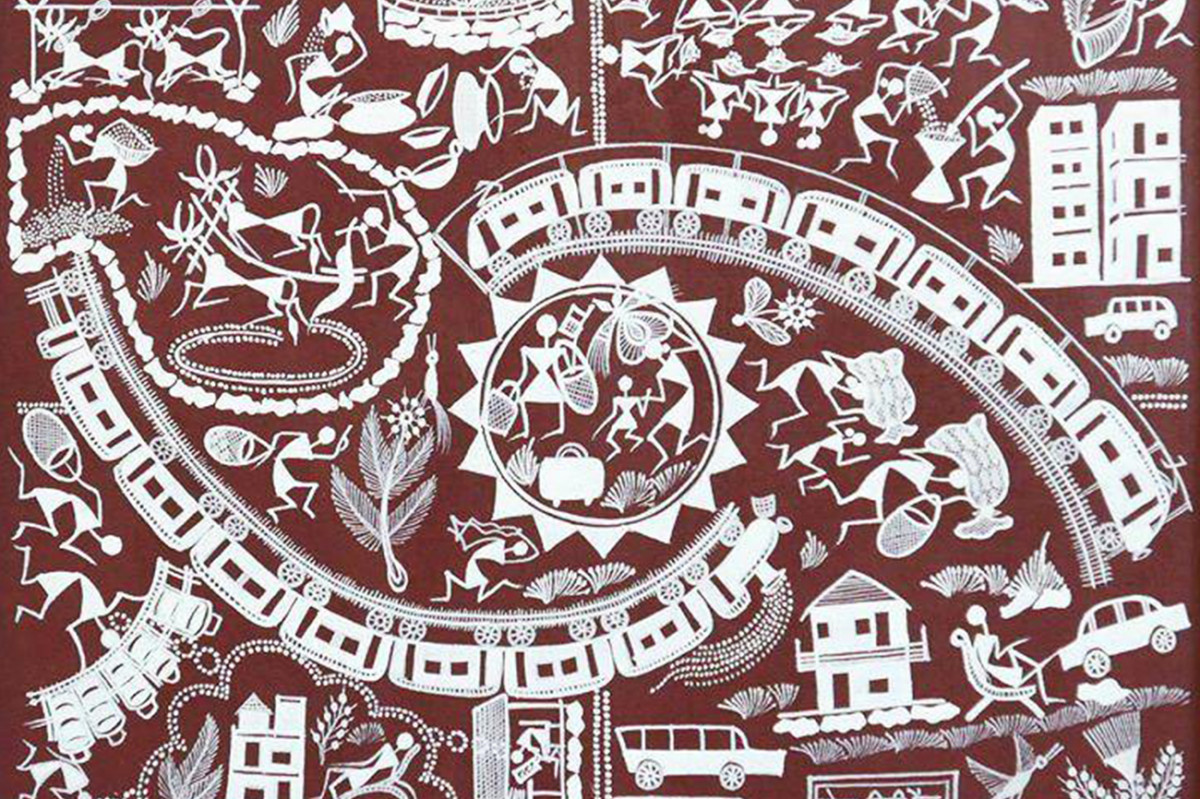
Warli Painting of India
This form of art dates back to 2500 BCE, and it was practiced by the Warli tribes belonging to Thane and Nasik in Maharashtra. Etymologically, ‘waral’ in Warli means a piece of land. As suggested, ancestors would spare a part of their land, amidst a forest, to irrigate. Subsequently, the Warli tribe became known for its minimalist art form.
The Warli tribe is among the largest tribes of Maharashtra region and lives on the outskirts of Mumbai, in the North Sahyadri region. The womenfolk of this tribe paint indigenous paintings and art known as Warli tribal wall paintings.
The tribal art style dates back to the 10th century AD and has traditionally been used by the tribals to decorate walls of their mud houses on special occasions like harvest and weddings. It generally takes inspiration from normal life routine and surroundings. It portrays daily activities like farming, praying, dancing, hunting, etc.
Tribal people express themselves in vivid styles through paintings which they execute on the walls of their house. This was the only means of transmitting folklore to a populace not acquainted with the written word.
The colors and materials used for the paintings are derived from nature like brown and orange from henna, indigo from dye, red from bricks and white from thick rice paste. They use chewed bamboo sticks as paint brushes to create the paintings.
Geometrical patterns in white against a yellow or red background are some of the main themes. Warli paintings were mainly done by married women to celebrate a wedding, and they were also used to decorate huts of the Warli tribes.
Warli Painting of India
The Warli tribe is among the largest tribes of Maharashtra region and lives on the outskirts of Mumbai, in the North Sahyadri region. The womenfolk of this tribe paint indigenous paintings and art known as Warli tribal wall paintings.
The tribal art style dates back to the 10th century AD and has traditionally been used by the tribals to decorate walls of their mud houses on special occasions like harvest and weddings. It generally takes inspiration from normal life routine and surroundings. It portrays daily activities like farming, praying, dancing, hunting, etc.
Tribal people express themselves in vivid styles through paintings which they execute on the walls of their house. This was the only means of transmitting folklore to a populace not acquainted with the written word.
The colors and materials used for the paintings are derived from nature like brown and orange from henna, indigo from dye, red from bricks and white from thick rice paste. They use chewed bamboo sticks as paint brushes to create the paintings.
Geometrical patterns in white against a yellow or red background are some of the main themes. Warli paintings were mainly done by married women to celebrate a wedding, and they were also used to decorate huts of the Warli tribes.
Warli Painting of India
Tuesday, July 20, 2021
Painting during the reign of Jahangir
Jahangir (1605 – 1627 AD) was the most enthusiastic patron of the Mughal painting. Mughal painting reached its climax under Jahangir when apart from painting hunting, battle and court scenes, special importance was given on portrait painting and paintings of animals, flowers etc.
Like his ancestors Jahangir maintained his own atelier and all the renowned artists and painters of his noble father's atelier were not only retained, but the rising painters were also employed Jahangir was an aristocrat with an eye of a naturalist, the vision of a poet and heart of a saint and like his noble father treated all religious equally.
Under his patronage, the Mughal painting achieved naturalism and scientific accuracy of the highest degree. The curiosity and wonderment that the Emperor had for nature and people around him is reflected in the works that he commissioned.
Mansur, Abdul Hasan and Bishandas were the great painters in the court of Jahangir. Jahangir has bestowed the title of Nadir-ulAsr on Mansur. During this period, the influence of western painting on the Mughal painters became more pronounced.
Jahangir was sympathetic towards Indian painters and appreciated their talent and appeared them in numerous ways and employed them for mural decorations and were also assisted by Persian artists.
One of the contributions was the use of aroma behind the heads of the Mughal emperors in paintings. This practice, which was originally adopted by the Mahayana Buddhist artists, was extensively utilized in the Christian art of the middle Ages.
Jahangir’s fascination for European art and theme prompted him to have more such works in his collection. Many celebrated religious Christian themes were also produced in the royal atelier of Jahangir.
Painting during the reign of Jahangir
Like his ancestors Jahangir maintained his own atelier and all the renowned artists and painters of his noble father's atelier were not only retained, but the rising painters were also employed Jahangir was an aristocrat with an eye of a naturalist, the vision of a poet and heart of a saint and like his noble father treated all religious equally.
Under his patronage, the Mughal painting achieved naturalism and scientific accuracy of the highest degree. The curiosity and wonderment that the Emperor had for nature and people around him is reflected in the works that he commissioned.
Mansur, Abdul Hasan and Bishandas were the great painters in the court of Jahangir. Jahangir has bestowed the title of Nadir-ulAsr on Mansur. During this period, the influence of western painting on the Mughal painters became more pronounced.
Jahangir was sympathetic towards Indian painters and appreciated their talent and appeared them in numerous ways and employed them for mural decorations and were also assisted by Persian artists.
One of the contributions was the use of aroma behind the heads of the Mughal emperors in paintings. This practice, which was originally adopted by the Mahayana Buddhist artists, was extensively utilized in the Christian art of the middle Ages.
Jahangir’s fascination for European art and theme prompted him to have more such works in his collection. Many celebrated religious Christian themes were also produced in the royal atelier of Jahangir.
Painting during the reign of Jahangir
![]() |
A
Prince and a Hermit |
Sunday, September 6, 2020
India Mughal painting
The Mughal school was found by Akbar under whom it developed into a class of its own. The Mughal school of painting in India coincides with the period of Mughal dynasty.
During the reign of the Mughals in the mid-16th century, the subjects of miniature paintings included portraits, court scenes, flora and fauna. In the Rajput (in Rajasthan) and Pahari (in the Punjab hills) courts, the paintings continued to bring to life poetry, age old legends, religious mythology and the moods of love and changing seasons.
It was essentially a product of the Mughal court. In form and content, it happens to be a departure from collective community tradition just as the Mauryan art was more than a millennium and a half before.
Mughal painting marks a unique a blending of Persian and Indian ideas. Mughal painting was essentially a court art, developed under the patronage of the ruling Mughal emperors and began to decline when the rulers lost interest.
Mughal artists due to new and more sophisticated techniques, learned both from Persian and European traditions. Pigments too contributed significantly to the distinctiveness of a style, fri contrast to pre-Mughal paintings, those of the Mughal and Rajput school reflect an enormous increase in the range of colors.
The subjects treated were generally secular, revolving around themes like battles, court scenes, receptions, legendary stories, hunting scenes, wildlife, portraits, and the likes.
The ancestral home of Mughal painting was originally in Samarkand and Herat where, under the Timurid kings in the fifteenth century, Persian art reached its zenith. An offshoot of Central Asian Art, the term, Indo-Persian, or more precisely, still, Indo-Timurid, is regarded by some authorities as a more suitable name for this particular development of Indian painting.
It was under Jahangir that Mughal painting attained its greatest perfection. Jahangir constantly refers to the court painters in his memories and mentions the valuable presents and the honors which he bestowed upon them.
India Mughal painting
During the reign of the Mughals in the mid-16th century, the subjects of miniature paintings included portraits, court scenes, flora and fauna. In the Rajput (in Rajasthan) and Pahari (in the Punjab hills) courts, the paintings continued to bring to life poetry, age old legends, religious mythology and the moods of love and changing seasons.
It was essentially a product of the Mughal court. In form and content, it happens to be a departure from collective community tradition just as the Mauryan art was more than a millennium and a half before.
Mughal painting marks a unique a blending of Persian and Indian ideas. Mughal painting was essentially a court art, developed under the patronage of the ruling Mughal emperors and began to decline when the rulers lost interest.
Mughal artists due to new and more sophisticated techniques, learned both from Persian and European traditions. Pigments too contributed significantly to the distinctiveness of a style, fri contrast to pre-Mughal paintings, those of the Mughal and Rajput school reflect an enormous increase in the range of colors.
The subjects treated were generally secular, revolving around themes like battles, court scenes, receptions, legendary stories, hunting scenes, wildlife, portraits, and the likes.
The ancestral home of Mughal painting was originally in Samarkand and Herat where, under the Timurid kings in the fifteenth century, Persian art reached its zenith. An offshoot of Central Asian Art, the term, Indo-Persian, or more precisely, still, Indo-Timurid, is regarded by some authorities as a more suitable name for this particular development of Indian painting.
It was under Jahangir that Mughal painting attained its greatest perfection. Jahangir constantly refers to the court painters in his memories and mentions the valuable presents and the honors which he bestowed upon them.
India Mughal painting
Tuesday, September 18, 2012
Indian cave painting in Bhimbetka
The first discovery of prehistoric rock paintings in the world was made in India. It was first discovered as early as 1870 but the chronology was only established after the excavations at Modi in 1959 and Bhimbetka in 1972.
At present some 150 sites of rock art are known in the country. Bhimbetka is the largest clusters of pained rock art shelters in the world. It is situated 45km of Bhopal. These caves are more than 600 in number and spread within a radius of 10 km.
In this complex of sandstone caves and rockshelters geometric microliths of chalcedony are found in preceramic deposit. Pieces or red and yellow ocher occur in the same deposits, these having been used for painting of walls and ceilings.
Mostly the painted caves are of Mesolithic age in which elephant, rhinoceros, bear, wild bear, cow bullock, buck, deer and monkeys have be painted. The paintings are of red and white color while some were green and yellow color also.
Two petroglyphs evacuated in Auditorium Cave, Bhimbetka, were covered by the uppermost part of a substantial Acheulian layer, suggesting that they are the oldest known rock art in the world.
Indian cave painting in Bhimbetka
At present some 150 sites of rock art are known in the country. Bhimbetka is the largest clusters of pained rock art shelters in the world. It is situated 45km of Bhopal. These caves are more than 600 in number and spread within a radius of 10 km.
In this complex of sandstone caves and rockshelters geometric microliths of chalcedony are found in preceramic deposit. Pieces or red and yellow ocher occur in the same deposits, these having been used for painting of walls and ceilings.
Mostly the painted caves are of Mesolithic age in which elephant, rhinoceros, bear, wild bear, cow bullock, buck, deer and monkeys have be painted. The paintings are of red and white color while some were green and yellow color also.
Two petroglyphs evacuated in Auditorium Cave, Bhimbetka, were covered by the uppermost part of a substantial Acheulian layer, suggesting that they are the oldest known rock art in the world.
Indian cave painting in Bhimbetka
Subscribe to:
Posts (Atom)
The Most Popular Posts
-
Vincent van Gogh painted the picture in April-May 1885, at Nuenen, where van Gogh’s parents had lived since 1883. Vincent lived there for t...
-
Dora Maar au Chat It was painted in 1941 by Pablo Picasso. It depicts Dora Maar, the painter’s Croatian mistress, seated on a chair with s...
-
Art in the Old Stone Age From the moment in 1879 that cave paintings were discovered at Altamira , scholars wondered why the hunters of the ...
-
The Chaldeans came originally from northeast Mesopotamia and took control of Babylon in 625 BC. Geographically, Chaldea occupied a central...
-
In 1892, Matisse began study with Gustavo Moreau. After 5 years Moreau told Matisse that it was time for him to produce a major work to demo...


.png)